
Behind the Stealth: Understanding the Theory that made Stealth possible [i]
The scientific background behind the stealth

Introduction
Over the course of my career, I have had the privilege of writing several books dedicated to the fascinating and complex world of stealth technology. These works have primarily focused on the final products of engineering ingenuity, such as stealth airplanes and air defense systems, where the principles of low observability are discussed in the context of real-world platforms. In addition to these long-form publications, I have engaged with a broader audience through numerous posts on social media platforms like X, where I address specific questions and clarify misconceptions about how stealth works. Through these channels, I have encountered a wide range of readers, from seasoned aerospace engineers to passionate aviation enthusiasts who are curious about the technology shaping modern warfare.
Despite the abundance of information available today, there remains a significant gap in the literature surrounding stealth technology. There are many more articles and books available than ever before, yet what is missing is a resource that strikes the right balance between technical accuracy and accessibility. Much of the existing material falls into one of two extremes. On the one hand, there are highly academic texts filled with complex mathematical derivations, dense electromagnetic theory, and a bunch of equations that most stealth enthusiasts will never understand or need to use. On the other hand, there are popular accounts that simplify the subject to the point of inaccuracy, often relying on myths and science fiction concepts rather than physical reality.
This dichotomy creates a frustrating situation for the ordinary reader who wants to know more about what is behind stealth technologies. They are often told that understanding radar cross-section reduction requires a deep background in calculus and electromagnetic field theory. While it is true that the underlying physics is complex, the fundamental concepts can be grasped without solving Maxwell’s equations. The barrier to entry should not be a lack of mathematical training, but rather a lack of clear, conceptual explanations that translate high-level engineering into understandable ideas.
What is needed is a simplified approach that respects the reader’s intelligence while acknowledging the subject’s complexity. This means explaining the very complex technical aspects at a level that is understandable to those who want to understand the principles without getting lost in the weeds of derivation. It focuses on the physical intuition behind the technology, such as how shapes deflect radar waves, how materials absorb energy, and how edges create scattering patterns, rather than focusing on the precise numerical methods used to calculate them.
This article aims to demystify stealth technology for the avid aviation enthusiast. It draws upon the foundational physics that governs electromagnetic scattering but presents them through analogies and clear descriptions rather than abstract formulas. The aim is to provide a solid conceptual framework that enables readers to understand why certain design choices are made, how stealth aircraft differ from conventional ones, and what limitations the technology faces. By stripping away the unnecessary mathematical overhead, we can focus on the engineering logic that drives innovation in low-observable design.
In the following part, we will explore the core principles that make stealth possible. We will discuss the interaction between radar waves and aircraft surfaces, the role of edge alignment, and the trade-offs involved in designing a vehicle that must remain invisible to sensors while still flying effectively. This discussion is intended to empower readers to distinguish fact from fiction when discussing stealth capabilities. Whether you are a hobbyist tracking military aviation developments or a student considering a career in aerospace engineering, the goal is to provide a clear window into a field that is often shrouded in secrecy and confusion.
The journey through stealth technology is one of balancing competing requirements. It is not just about making an aircraft invisible; it is about managing signatures across multiple spectrums while maintaining performance, payload, and cost effectiveness. By understanding the basic mechanisms of detection and avoidance, readers can appreciate the immense engineering effort required to produce platforms like the F-117, the B-2, or the F-35, to name just a few. This article seeks to honor that effort by explaining it in a way that is both technically sound and broadly accessible.
Ultimately, the value of this work lies in its ability to connect theoretical physics to practical applications. It is not enough to know that stealth works; it is far more rewarding to understand why it works. By providing a narrative that is free from the intimidation of advanced mathematics, I hope to invite more people into the conversation about defense technology. This is not about dumbing down the science, but rather about clarifying it. It is about ensuring that the fascinating story of stealth technology is available to everyone curious enough to ask how it works. This article is my contribution to that effort, offering a clear, accurate, and engaging pathway into the subject for all readers.
Behind the final product—the stealth aircraft—stood one of the pivotal breakthroughs in electromagnetic science, unlocked by the young Soviet scientist Pyotr Ufimtsev. This article explores his discovery and its lasting impact.
Understanding the Physical Theory of Diffraction: From Soviet Labs to Stealth Aircraft
When Waves Meet Edges
Imagine throwing a stone into a calm pond. The ripples spread outward in perfect circles until they encounter an obstacle. What happens next? The waves bend around the edges, create intricate patterns, and interfere with each other in ways that seem almost magical. This phenomenon, called diffraction, is fundamental to how all waves behave, whether they are water waves, sound waves, or electromagnetic waves like radio signals and light.
For engineers and physicists working with radar, antennas, and wireless communications, understanding diffraction isn’t just academic curiosity - it’s essential. When a radar signal encounters an aircraft, a ship, or even a building, the way that signal scatters determines whether the object can be detected, tracked, or perhaps even hidden. Fifty years ago, a breakthrough theoretical framework emerged that transformed our ability to predict and control these complex wave interactions. This framework is called the Physical Theory of Diffraction, or PTD.
Developed by Russian physicist Pyotr Ufimtsev and first presented publicly in 1962, PTD provides a powerful way to calculate how electromagnetic waves scatter from complex objects, especially those with sharp edges, corners, and curved surfaces. What began as a method to improve radar calculations has since influenced fields ranging from antenna design to stealth technology. This article explores the origins, core concepts, and lasting impact of this remarkable theory, making its sophisticated ideas accessible to a wider audience.

The Birth of PTD: A Cold War Laboratory Insight
The story of PTD begins in 1954 at a highly classified Soviet research institute in Moscow. Fresh from university, young Pyotr Ufimtsev joined the Central Research Radio Engineering Institute, a premier facility established during World War II to advance military radio technology. The institute was led by distinguished scientists, including Vladimir Fock and Mikhail Leontovich, whose foundational work in wave physics would profoundly influence Ufimtsev’s thinking.
At the time, engineers faced a practical challenge: how to calculate the radar cross-section (RCS) of real-world objects like missiles and aircraft. Simple shapes like spheres could be analyzed with existing mathematics, but complex objects with edges, curves, and varying materials defied easy calculation. The standard approach, called Physical Optics, worked well for smooth surfaces but failed dramatically near sharp edges where waves behave unpredictably.
Ufimtsev’s breakthrough came from studying an elegant mathematical solution developed decades earlier by Arnold Sommerfeld for wave diffraction at a wedge. Sommerfeld showed that the total electromagnetic field on a wedge surface could be separated into two distinct parts: a “geometrical optics” component representing direct reflection, and a “diffracted” component arising from the edge itself. This insight sparked a revolutionary idea: what if we could treat any complex object as a collection of local wedge-like features, each contributing its own diffracted wave?
From this foundation, Ufimtsev introduced the central concept of PTD: the separation of surface currents into two components. The uniform component represents the current that would exist if the surface were an infinite, flat plane—essentially the Physical Optics approximation. The nonuniform component captures everything else: the additional currents generated by edges, corners, curvature changes, material transitions, and other surface irregularities. By focusing on calculating just this nonuniform “fringe” current, PTD dramatically simplifies the analysis of complex scattering problems.

Core Concepts Made Clear: Edge Waves and Shadow Radiation
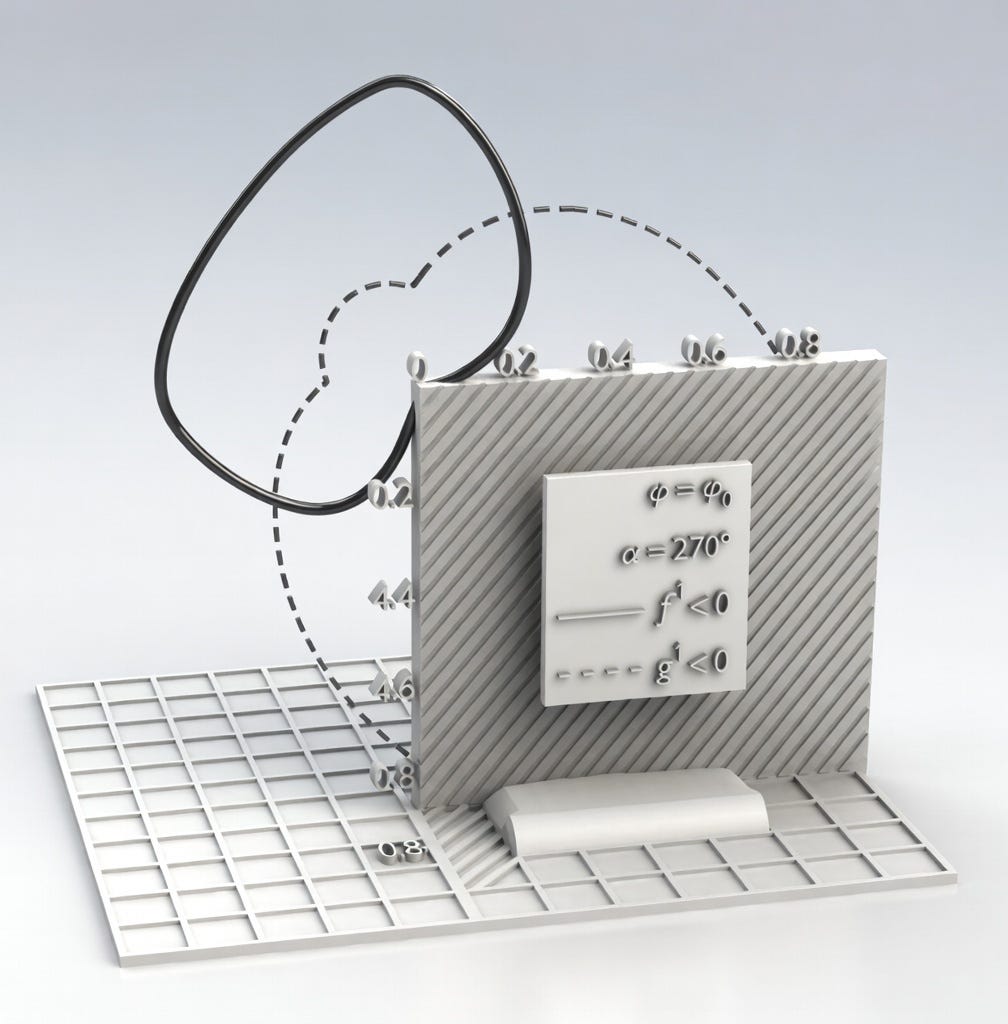
To understand how PTD works in practice, consider what happens when a radar wave strikes an aircraft wing. The uniform component of the surface current produces the predictable, mirror-like reflection that Physical Optics can handle. But near the wing’s sharp leading edge, something more complex occurs. The wave bends around the edge, creating secondary radiation that spreads in many directions. PTD models this as an “edge wave”, a localized source of scattered energy emanating from the geometric discontinuity.
This edge wave concept proves remarkably powerful. Instead of solving Maxwell’s equations for the entire complex object, engineers can calculate the contribution from each significant edge, corner, or curvature change, then sum these contributions. Mathematical machinery involves asymptotic approximations - simplified expressions that become increasingly accurate as the object size grows relative to the wavelength. For radar applications, where wavelengths are typically centimeters and aircraft are meters in size, these approximations work exceptionally well.
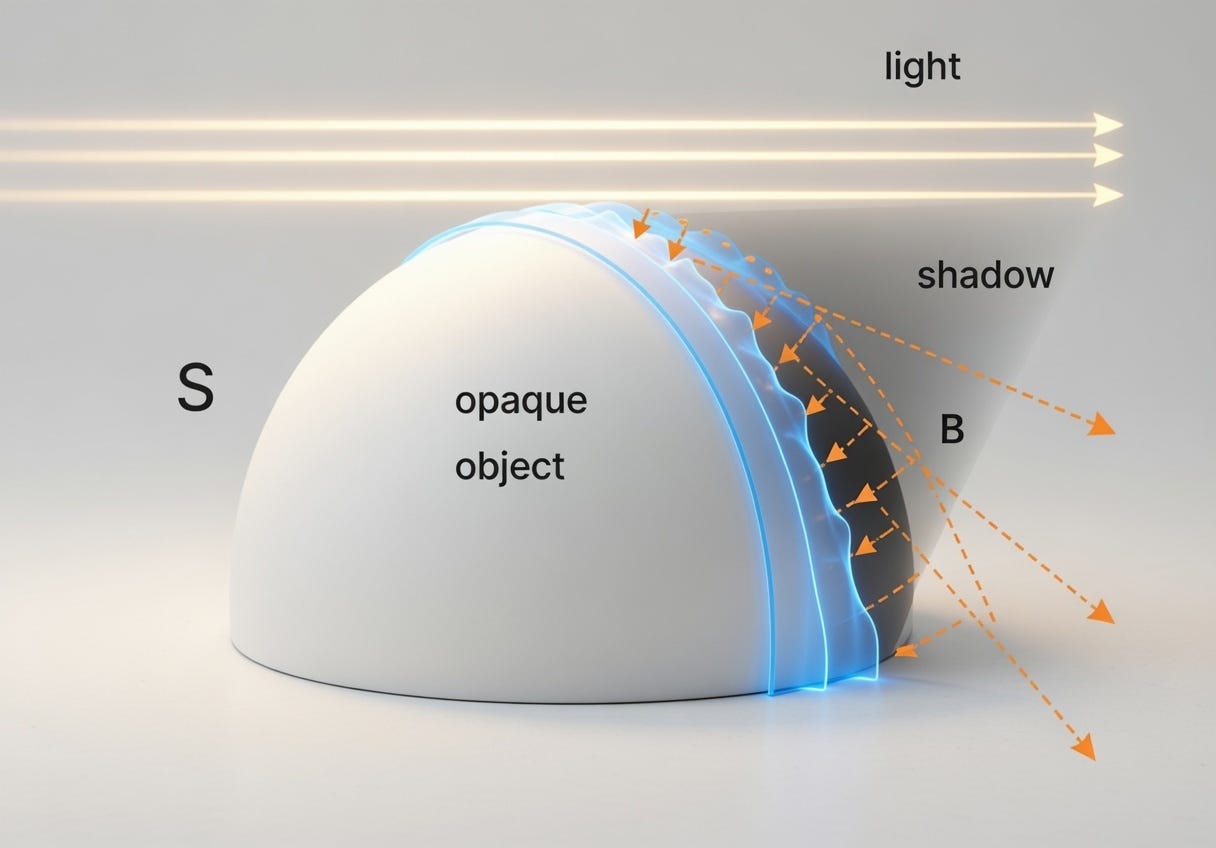
One of PTD’s most surprising discoveries emerged from studying an extreme theoretical case: perfectly absorbing objects, or “black bodies” in electromagnetic terms. When Ufimtsev analyzed how such objects scatter waves, he identified a phenomenon he called shadow radiation. Counterintuitively, even an object that absorbs all incident energy on its illuminated side still scatters energy due to wave diffusion near the shadow boundary - the line separating lit and dark regions behind the object.
Shadow radiation has profound implications. Ufimtsev proved that different black bodies producing the same geometric shadow generate identical shadow radiation patterns. Even more striking, the total power in this shadow radiation equals exactly half the power scattered by a perfectly reflecting object of the same shape. This means that no matter how perfect an absorbing coating might be, it can, at best, only halve an object’s radar signature—the remaining half exists as unavoidable shadow radiation. This fundamental limit has important consequences for stealth technology and radar detection strategies.
From Theory to Practice: Engineering Applications and Stealth
While PTD began as a theoretical advance, its practical impact quickly became apparent. In the Soviet Union, PTD-based calculations for cylindrical objects proved so accurate that they were used to calibrate radar test ranges and anechoic chambers—facilities designed to simulate free-space conditions for antenna testing. The theory’s ability to predict not just the magnitude but also the detailed pattern of scattered energy, including polarization effects and lobe structures, made it invaluable for engineering validation.
Perhaps the most famous application of PTD emerged unexpectedly in the United States. During the development of stealth aircraft in the 1970s and 1980s, American engineers at Lockheed’s Skunk Works discovered Ufimtsev’s translated work. They recognized that PTD provided exactly the tools needed to predict how aircraft shapes would scatter radar energy. By carefully designing faceted surfaces and edge alignments to minimize the nonuniform current contributions, engineers could dramatically reduce an aircraft’s radar cross-section.
The F-117 Nighthawk and B-2 Spirit stealth aircraft both benefited from PTD-based analysis. While many factors contribute to stealth—materials, coatings, and electronic countermeasures, the fundamental shaping principles rely on controlling diffraction from edges and discontinuities, precisely what PTD excels at predicting. Ironically, a theory developed in a Soviet military laboratory became instrumental in the development of some of America’s most advanced military platforms.


Beyond stealth, PTD finds applications in numerous engineering domains. Antenna designers use it to predict sidelobe patterns and mutual coupling in array systems. Wireless communication engineers apply it to model signal propagation in urban environments where buildings create complex diffraction patterns. Even acoustic engineers have adapted PTD concepts to analyze sound scattering from complex structures.
PTD and GTD: Complementary Perspectives on Wave Behavior
No discussion of diffraction theory would be complete without mentioning the Geometrical Theory of Diffraction (GTD), developed independently by Joseph Keller around the same time as PTD. While both theories address high-frequency wave scattering, they approach the problem from different perspectives that ultimately prove complementary.
PTD is fundamentally a source-based theory. It focuses on calculating the actual electromagnetic currents induced on an object’s surface and then determining the radiation they produce. This approach provides physical insight into where and how scattering originates, making it particularly valuable for understanding polarization effects, material dependencies, and near-field behavior.
GTD, by contrast, is a ray-based theory. It extends classical geometrical optics by introducing diffracted rays that emanate from edges and other discontinuities, following specific diffraction coefficients and propagation rules. This ray-tracing approach excels at visualizing wave paths and is computationally efficient for large, complex scenarios.
Despite their different formulations, PTD and GTD share a deep mathematical connection. Both rely on the localization principle: at high frequencies, the diffraction behavior at any point depends primarily on the local geometry near that point, not on the object’s global shape. This principle allows both theories to build complex solutions from simple canonical problems, such as wedge diffraction.
In fact, GTD can be derived mathematically from PTD through asymptotic evaluation of the radiation integrals. The diffracted rays of GTD correspond to the far-field radiation patterns of PTD’s edge currents. This relationship means engineers can choose the framework best suited to their specific problem: PTD for detailed physical understanding and near-field analysis, and GTD for efficient far-field prediction and ray visualization.
Elementary Edge Waves: Building Complex Solutions from Simple Components
A particularly elegant extension of PTD is the concept of elementary edge waves. Just as Huygens’ principle allows us to construct complex wavefronts from simple spherical wavelets, elementary edge waves provide building blocks for analyzing diffraction from arbitrarily shaped edges.
The key insight is that any curved edge can be approximated as a series of small straight segments. For each segment, we can calculate the diffracted field using canonical wedge solutions, then integrate these contributions along the entire edge. This approach handles complex geometries while maintaining the computational efficiency of analytical approximations.
Advanced versions of elementary edge wave theory address challenging scenarios such as grazing incidence (where waves skim nearly parallel to a surface), slope diffraction (where the angle of incidence varies along an edge), and multiple diffraction (where waves scatter from one edge to another before reaching the observer). These extensions have made PTD applicable to an ever-wider range of practical problems.
One subtle but important refinement involves polarization coupling. When waves strike an edge at oblique angles, the interaction between electric and magnetic field components becomes complex. Early PTD formulations missed certain coupling effects, but later refinements correctly account for how edge charges and currents generate cross-polarized scattered fields. These details matter for applications such as polarimetric radar, where polarization information helps distinguish different target types.
Accuracy and Limitations: Knowing What PTD Can Do
Like any engineering approximation, PTD has well-defined strengths and limitations. Rigorous mathematical analysis shows that PTD provides a first-order high-frequency approximation to the scattered fields. This means it correctly captures the dominant terms in the asymptotic expansion as the object size becomes large compared to the wavelength.
For many engineering applications, this first-order accuracy is entirely sufficient. The errors introduced by neglecting higher-order terms are typically small relative to other uncertainties, such as material property variations, manufacturing tolerances, or environmental effects. Moreover, higher-order corrections often involve significantly more complex mathematics with diminishing practical returns.
PTD’s accuracy has been extensively validated through comparison with exact analytical solutions for canonical problems, controlled laboratory measurements, and full-wave numerical simulations. For example, in the classic problem of plane wave diffraction by a conducting strip, PTD correctly predicts the first three terms in the asymptotic expansion of the total scattering cross-section—a remarkable achievement for an approximate theory.
However, PTD is not universally applicable. Its high-frequency asymptotic nature means it becomes less accurate when object dimensions approach the wavelength. It also assumes perfectly conducting surfaces in its basic form, though extensions exist for impedance boundaries and absorbing materials. For problems involving strong multiple scattering, resonant effects, or highly complex material properties, hybrid approaches combining PTD with full-wave numerical methods often provide the best balance of accuracy and efficiency.
Future Directions: PTD in a Changing Technological Landscape
As technology evolves, so do the applications and extensions of PTD. Modern research explores several promising directions:
Complex Materials: Extending PTD to handle metamaterials, frequency-selective surfaces, and other engineered materials with exotic electromagnetic properties.
Broadband and Transient Analysis: Adapting asymptotic techniques for ultra-wideband signals and time-domain applications where frequency-domain approximations may not suffice.
Hybrid Computational Methods: Combining PTD’s efficiency for electrically large structures with numerical methods like finite-element or method-of-moments solvers for complex details, creating multi-scale simulation tools.
Machine Learning Integration: Using PTD to generate training data for neural networks that can rapidly predict scattering behavior, potentially accelerating design optimization processes.
Quantum and Nanoscale Extensions: Exploring whether asymptotic diffraction concepts can inform wave behavior at scales where quantum effects become significant.
Perhaps most importantly, PTD continues to serve as an educational framework. Its physical intuition, which separates predictable, uniform behavior from edge-generated diffraction, helps students and engineers develop mental models for wave scattering that purely numerical approaches cannot provide.
Conclusion: The Enduring Legacy of Physical Insight
Fifty years after its formal introduction, the Physical Theory of Diffraction remains a cornerstone of high-frequency electromagnetic analysis. Its power lies not just in mathematical sophistication, but in physical insight: the recognition that complex wave phenomena can be understood by identifying and analyzing their fundamental sources.
From its origins in a Moscow laboratory to its role in shaping stealth technology, PTD demonstrates how fundamental theoretical advances can transform practical engineering. Its concepts - uniform and nonuniform currents, edge waves, shadow radiation - provide a language for discussing diffraction that bridges mathematical rigor and physical intuition.
For the wider audience, PTD offers a compelling lesson about the nature of scientific progress. Breakthroughs often come not from discarding existing knowledge, but from re-examining it with a fresh perspective. By asking a simple question, “What if we separate the predictable from the diffracted?”, Pyotr Ufimtsev opened a pathway that continues to guide engineers designing the communication, sensing, and stealth systems of tomorrow.
In an age of increasingly powerful computers and sophisticated numerical methods, the value of analytical theories like PTD might seem diminished. Yet the opposite is true. As problems grow more complex, the physical insight provided by well-founded asymptotic theories becomes more valuable, not less. PTD reminds us that understanding why waves behave as they do remains as important as calculating what they will do, and that sometimes, the most powerful tools are those that help us see the physics behind the mathematics.

The Ufimtsev framework represents one of the rare cases where:
A purely theoretical insight into electromagnetic theory fundamentally reshaped engineering practice.
By tracing the path: Maxwell → Helmholtz → Surface currents → Edge currents → Asymptotics → RCS scaling, Ufimtsev transformed diffraction from a correction term into a central scattering mechanism.
The enduring lesson of his work is this:
In high-frequency electromagnetics, discontinuities define observability.
His contribution was not merely mathematical - it changed how engineers think about shape, edges, and electromagnetic visibility in the wave regime.
If you like the article (and many more articles regarding military subjects will come), you can buy me a coffee:
https://www.buymeacoffee.com/mmihajloviW
[i] Edited by Piquet (EditPiquet@gmail.com)